Road fuel prices in May 2026 are high by any normal standard, and a small number of headline numbers are genuinely without precedent. But the fuller picture — the one road-trippers actually need — is more measured than the news cycle suggests. This note sets out where things stand as of the week of 4–10 May 2026, what's actually moved, what hasn't, and what it means if you're planning a trip in the next few weeks.
The numbers, briefly
The European Commission's Weekly Oil Bulletin for the week of 4 May puts the EU-27 simple-average price at €1.81 per litre for petrol and €1.93 per litre for diesel. These are the highest weekly readings ever recorded by that series. On a country basis the spread is wide — Malta at €1.34 petrol and €1.21 diesel on one end, the Netherlands at €2.39 petrol and €2.37 diesel on the other.
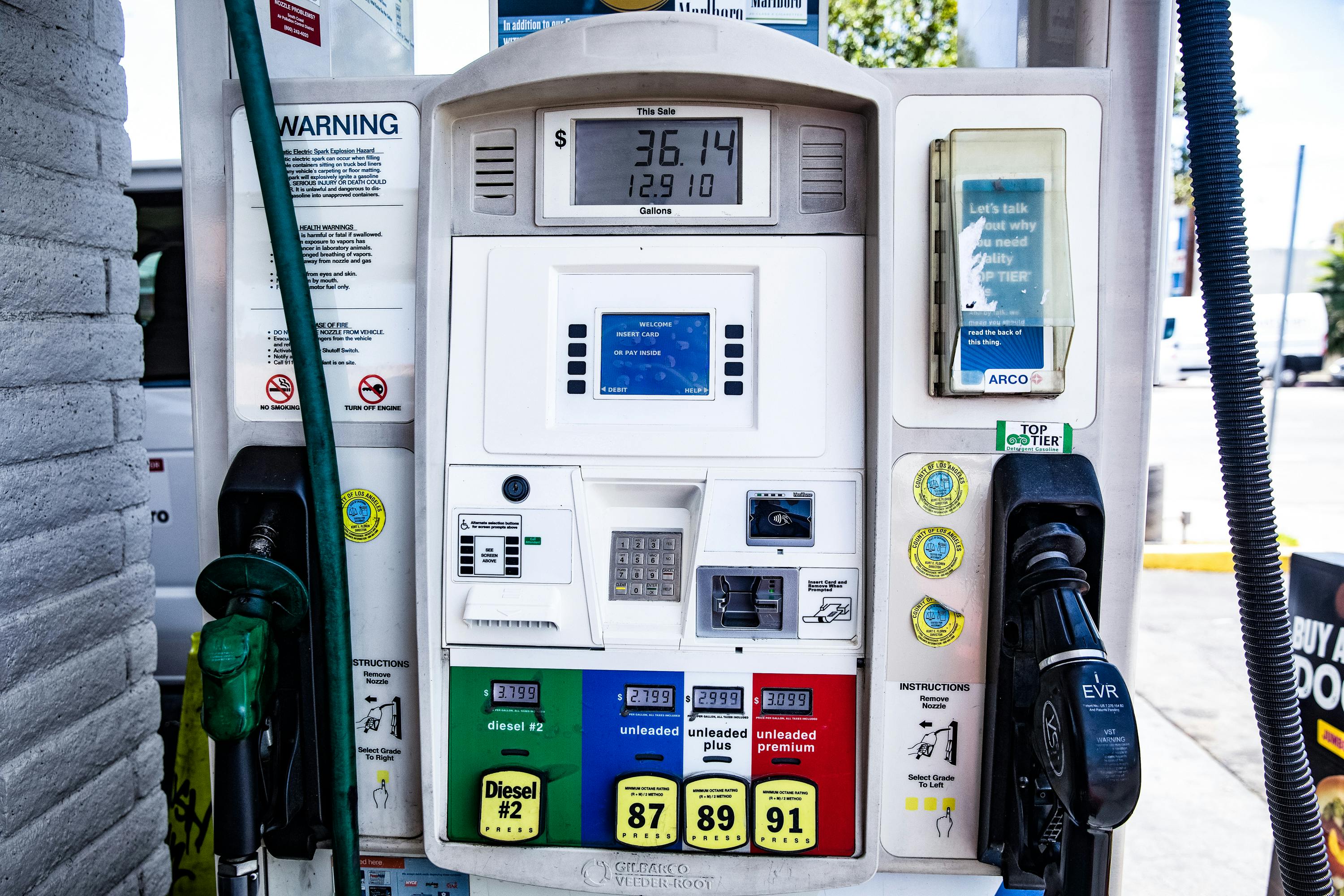
The United States national average for regular gasoline sat at $4.52 per gallon on 10 May (AAA), the highest weekly reading since August 2022. California's state-wide average reached $6.15 per gallon, with one Mono County station quoted at $7.00 earlier in the month. Canada's national average for regular gasoline was CAD $1.87 per litre in the week of 5 May, a level last seen briefly in mid-2022.
The UK's RAC Fuel Watch put national-average petrol at 157.7 pence per litre and diesel at 188.5 pence on 8 May — high, but well off the July 2022 records of 191.6p and 199.2p.
What's actually new, and what isn't
Most of the daily reporting around fuel prices uses the word "record" without distinguishing nominal records from inflation-adjusted ones. The distinction matters, because in real terms the picture is meaningfully less extreme than the headlines suggest.
Genuinely new nominal records. Germany set a new all-time pump record on 1 April 2026, with diesel reaching €2.425 per litre nationally before the government's €0.14/L energy-tax cut (the Tankrabatt) took effect on 1 May. France's diesel peaked at €2.31 per litre on 13 April. Several smaller European markets, including the Netherlands for diesel, are at or close to their nominal highs.
Records that are still standing. The 2022 peaks remain unchallenged in most of the world. The US all-time nominal high of $5.01/gallon (June 2022) is roughly 10% above today's level; adjusted for inflation, the gap is closer to 18%. The UK's July 2022 records are 17–18% above current prices in nominal terms — and around 30% in real terms. Canada's all-time peak from June 2022 is 13% above today nominally, 22% in real terms. Even in Germany and France, where 2026 has set new nominal records, the inflation-adjusted peaks from 2012 still hold.
This isn't an argument that prices are low. They aren't. It's an argument that "the worst ever" framing oversells what's happening. Today's situation looks closer to a late-2022 environment than to a genuinely unprecedented one.
A pump price is the number on the display. A real-terms price adjusts that number for inflation since the comparison date. Cumulative inflation since 2022 has been roughly 9–11% in the US and 14–17% in the eurozone, which means a 2022 price quoted in 2026 money is meaningfully higher than the number that was on the display at the time. For travel planning, the nominal price is what matters at the pump — but for "is this the worst it's ever been?" comparisons, real terms are the honest measure.
Why the spike happened, and where it goes
The proximate cause is the Iran/Hormuz conflict that began on 28 February 2026. The Strait of Hormuz normally carries roughly a fifth of global seaborne oil and a similar share of LNG, and disruption there has displaced around 14 million barrels per day of supply, according to the IEA's current estimate. Brent crude has traded in a wide range — $95 to $114 across recent weeks — settling near $100 per barrel at the end of the week of 4 May.
Two secondary factors are amplifying the impact regionally. European refining capacity took an additional knock on 1 May, when Russia halted Kazakh-origin crude transit via the northern leg of the Druzhba pipeline, cutting about 17% of feedstock to Germany's PCK Schwedt refinery. Brandenburg authorities project around 80% of normal May supply will be made up via alternative routing through Gdańsk. US refining capacity has shrunk by about 3% since the start of 2025 through scheduled closures at Phillips 66 Los Angeles, LyondellBasell Houston, and most recently Valero Benicia (idled at the end of April). California's price spike reflects this structural loss rather than any acute shortage.
Diplomatic developments mid-week — a one-page memorandum of understanding floated between the US and Iran — sent Brent down 11% intraday on Wednesday 7 May before partial recovery. Markets remain sensitive in both directions; another escalation or a credible ceasefire could shift retail prices by 10–30 cents per litre within one to two weeks.
Actual shortages, and what counts as one
The most important distinction in this market right now is between high prices, which are widespread, and physical shortages, which are not.
France is the only large European market with measurable physical disruption. On the morning of 9 May, the government's live station feed (prix-carburants.gouv.fr) showed 212 stations in full rupture out of roughly 9,700 — about 2.2% of the network — with another 357 short of diesel. The cause is a combination of strong demand around the May public holidays and TotalEnergies' €2.09 capped-price promotion drawing crowds. President Macron and TotalEnergies have publicly rejected the "shortage" framing; the network as a whole continues to operate.
Hungary sees intermittent localised stockouts at independent stations, structurally rather than acutely. The country's HUF 615/L diesel cap applies only to Hungarian-plated vehicles, which makes imports loss-making for independent operators and creates supply gaps the major chains do not see.
Slovakia's February emergency declaration is winding down. The diesel export ban was lifted on 10 April, and the foreign-plate surcharge along with the 10-litre canister rationing rule was scrapped on 8 May.
Everywhere else — Germany, Italy, Spain, the UK, the Benelux, the Nordics, Iberia, the United States, Canada — supply is flowing normally. The headline US story is the price level on the West Coast, not any disruption to actual fuel availability. Trans Mountain in Canada is running unapportioned for May. EIA weekly data shows nominal pipeline flows nationwide.
Government countermeasures
Several governments have moved to insulate motorists from the worst of the increase, with mixed effectiveness:
- Germany — €0.14/L energy-tax cut on petrol and diesel, 1 May–30 June. ADAC reports only 60–70% of the intended saving has been passed through at the pump in the first week.
- Italy — €0.20/L excise cut on diesel and €0.05/L on petrol, in force through 22 May.
- Poland — combined VAT reduction, excise cut, and ministerial maximum retail prices through 15 May. Pb95 is capped at 6.35 PLN/L (about €1.49), the largest single intervention in Europe.
- Hungary — caps for Hungarian-plated vehicles only, market prices for everyone else.
- Canada — federal excise on gasoline and diesel zeroed out on 20 April as a price-relief measure.
None of these reverse the spike. They are designed to take the edge off, and they do.
What it means for a road trip in the next few weeks
If you're driving in Europe between now and the end of May, the practical implications are reasonably small:
- Budget on the high side. A €1.90/L diesel average across Western Europe is realistic; €2.00–€2.20 in France, Germany, the Netherlands. Petrol broadly €0.10–€0.15 below diesel almost everywhere except the UK.
- Cross-border fuelling differences are slightly amplified by the current situation. Filling up in Spain before re-entering France, or in Slovenia before Italy, is worth marginally more right now than it usually is.
- For routes through France in May, expect occasional station-level disruption but no system-wide shortage. The government's live feed is the source to check the morning of departure if you're worried about a specific area.
- For routes through Hungary, independent stations are more likely to be dry than the major MOL, Shell or OMV branded sites. Plan fills at the larger chains.
- For US road trips, the California number is the outlier. Most of the country is paying $4.00–$4.70 for regular and budgeting accordingly.
Prices remain volatile and the underlying situation is unresolved. The most useful thing a road-tripper can do is check live prices on the day of travel rather than assume a number from last week is still current. That's a planning behaviour, not a panic measure.
Check live fuel prices on your route
WiseTrip Route Planner shows current per-station prices along your route in Germany, France, Spain and Italy, plus disruption alerts for any country in Europe.
Open Route Planner →